← worksMSc thesis2026
Open-weight LLMs as negotiators
Benchmarking Gemma, Mistral and Qwen in negotiation games, then testing Self-Refine and team deliberation.
MSc in Artificial Intelligence, FEUP/FCUP, University of Porto
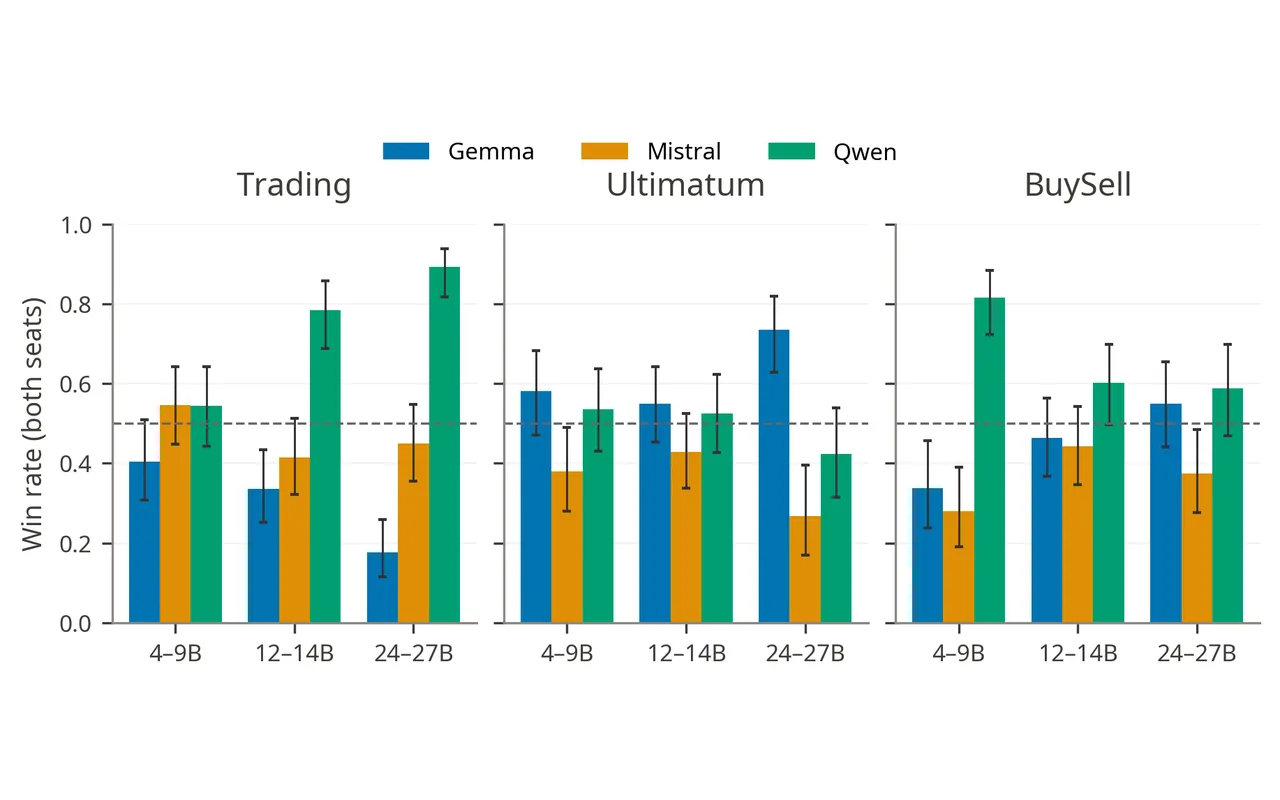
NegotiationArena (Bianchi et al., ICML 2024) showed how proprietary LLMs negotiate. Some of those models no longer exist. I replayed its three games with nine open-weight models and asked whether two inference-time techniques are worth their extra cost.
Research questions
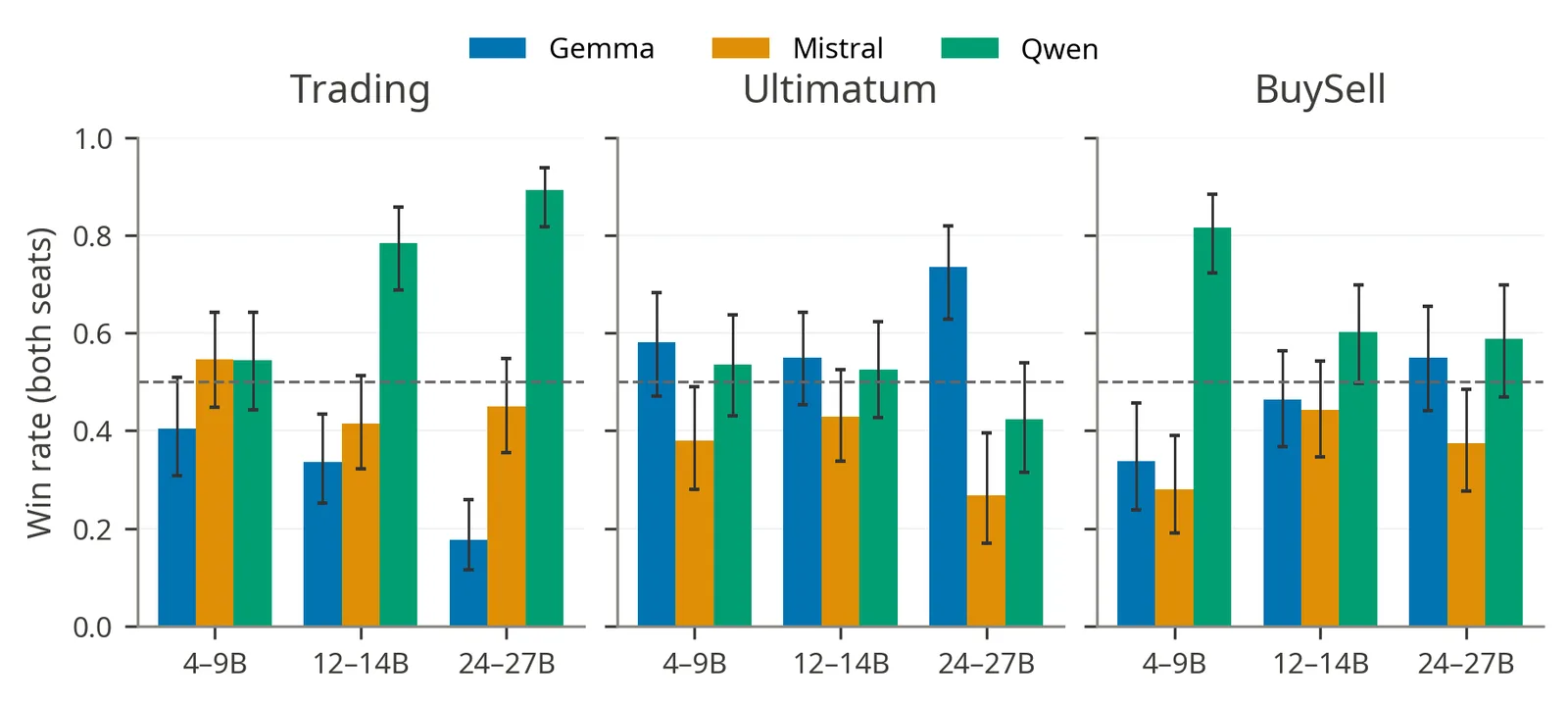
- RQ1. How well do open-weight LLMs perform in two-party negotiation scenarios?
- RQ2. To what extent do inference-time techniques change outcomes in multi-agent negotiation?
- Do the social-persona effects that raised GPT-4's win rate transfer to open-weight models?
- Does a draft → critique → rewrite loop (Self-Refine) improve outcomes enough to justify its cost?
- Does replacing one party with a deliberating team of models beat a single agent, and does team diversity matter?
The games
| Game | Setup | What is at stake |
|---|---|---|
| BuySell | Seller cost 40 ZUP, buyer value 60 ZUP | Agree a price or walk away |
| Trading | P1 {X:25, Y:5}, P2 {X:5, Y:25} | Exchange resources to maximise final holdings |
| Multi-turn Ultimatum | 100 ZUP pot | Proposer splits; responder accepts, counters or rejects |
Every game is an alternating conversation where moves are structured XML tags inside free-form messages. Metrics: win rate, average payoff, and completion rate (games reaching a valid terminal state).
Models
Nine models from three families at three parameter tiers, all run locally through HF transformers, 8-bit quantised at the largest tier.
| Tier | Gemma | Mistral | Qwen |
|---|---|---|---|
| 4–9B | Gemma 3 4B IT | Ministral 3 8B | Qwen3.5 9B |
| 12–14B | Gemma 3 12B IT | Ministral 3 14B | Qwen3 14B |
| 24–27B | Gemma 3 27B IT | Mistral Small 3.2 24B | Qwen3.5 27B |
Two inference-time techniques
Self-Refine
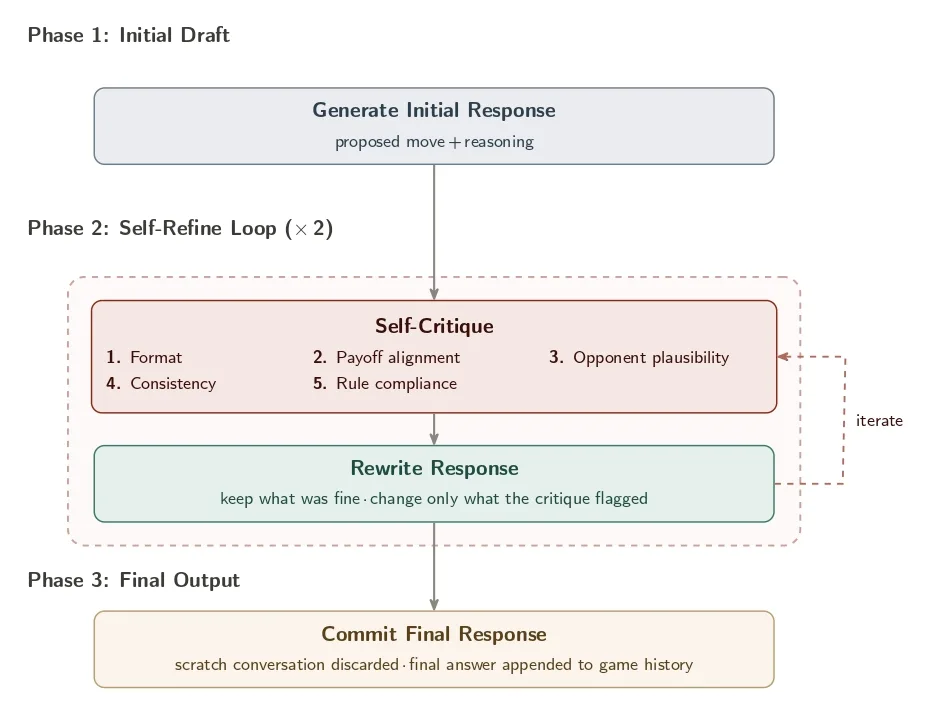
Before committing a move, the agent drafts it, critiques the draft along five negotiation-specific axes (format, payoff alignment, opponent plausibility, consistency, rule compliance), and rewrites it. The loop runs twice; only the final move enters the public game history.
Team negotiation
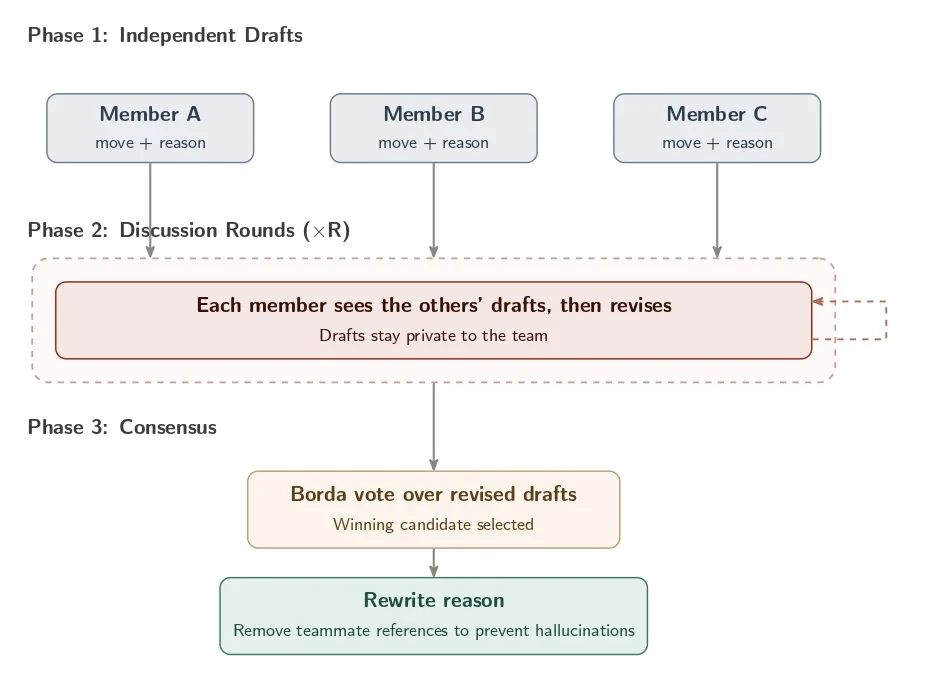
One negotiating party becomes a private team of three models. Members draft independently, revise over two discussion rounds while seeing each other's drafts, then rank the slate. A Borda count picks the committed move, and the rationale is rewritten in first person so the opponent never sees the team.
Engineering
- Forked NegotiationArena and added local open-weight inference, a parse-error retry loop that feeds parser errors back to the model (recovers most protocol failures of small models, ablated separately), Self-Refine and team agents with full trace logging.
- A single
experiments.yamldrives every run; launchers for two SLURM clusters (MIA, Deucalion) and for free Kaggle GPUs, with results pushed back to git branches. - A Streamlit explorer to read full game transcripts, including the private Self-Refine and deliberation traces.
