← worksResearch paper2025
Class imbalance vs synthetic tabular data
An empirical study of how imbalance degrades CTGAN, TVAE, RTVAE, DDPM and SMOTE as data synthesisers.
synthcitypymdmascikit-learn
With Maria Abreu, Moisés Santos, Carlos Soares, Marília Barandas and Mariana Oliveira · FEUP, LIACC, Fraunhofer AICOS Portugal
Synthetic data is increasingly used as a replacement for real datasets, not just as augmentation. Most synthesisers are themselves machine-learning models, so they should be vulnerable to class imbalance in their training data. We measured how much.
Question
How does increasing class imbalance in the training data affect the quality, privacy and downstream utility of fully synthetic tabular datasets?
Method
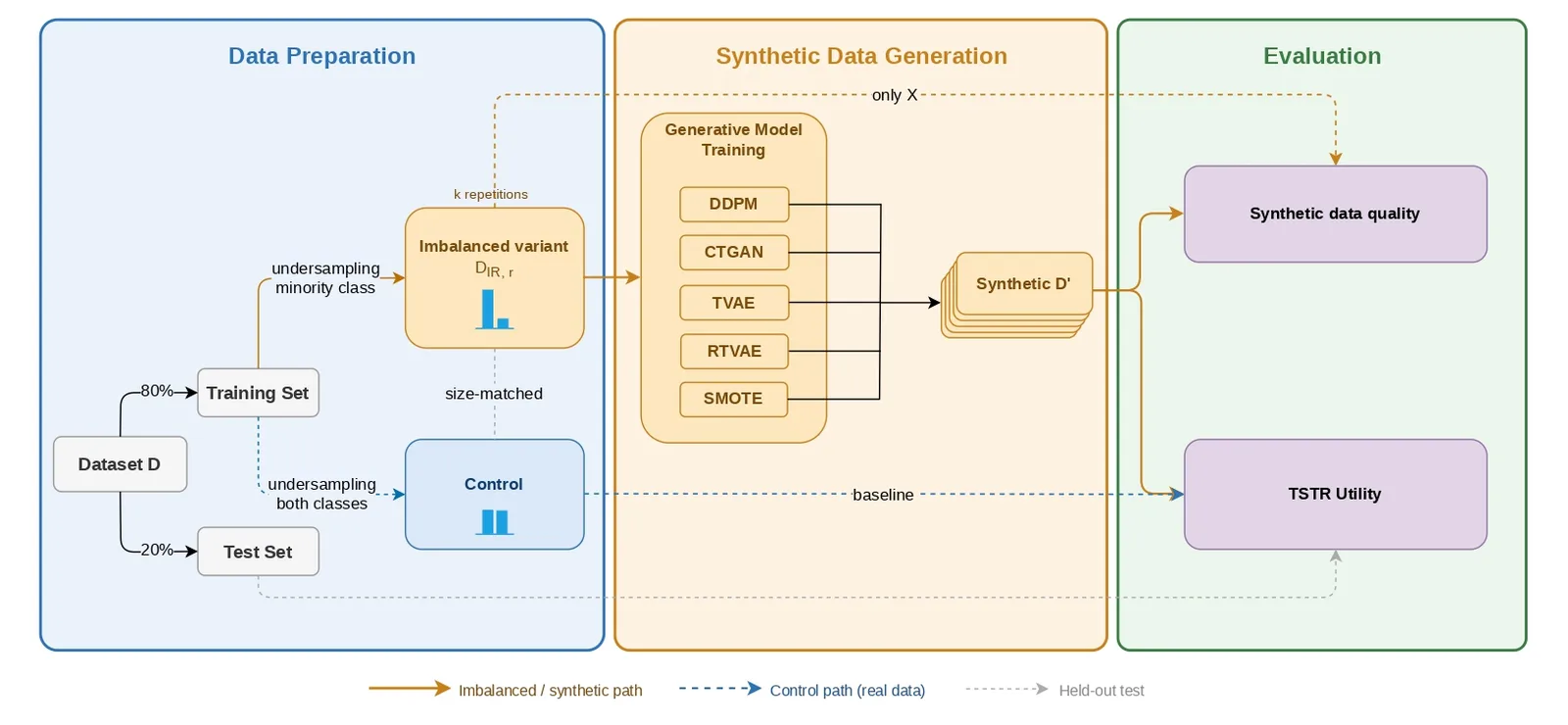
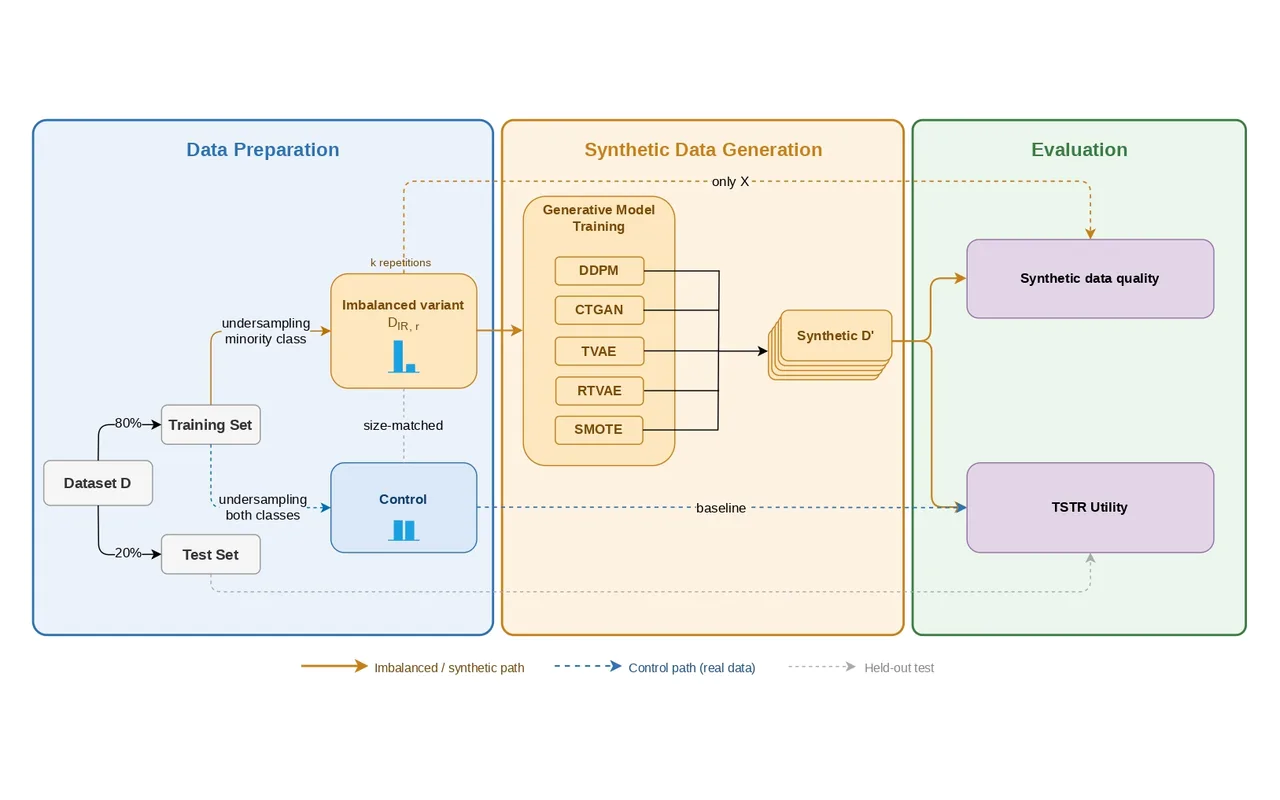
- Six benchmark datasets: Mammographic Mass, Monks, Vote, Phishing, Credit, Auto MPG.
- Imbalance ratios
IR ∈ {1, 3, 5, 7, 10, 20, 50, 100}forced by randomly undersampling the minority class, 10 repetitions each. - A size-matched control keeps the original class balance at the same sample size, so imbalance is isolated from data scarcity.
- Five generators (CTGAN, TVAE, RTVAE, DDPM and SMOTE used as a synthesiser) each trained on every variant, then asked to produce balanced synthetic sets.
- Quality and privacy from
pymdma; utility as TSTR (train on synthetic, test on real) classification.
Findings
- Utility degrades across most datasets and models as imbalance grows, even after controlling for sample size.
- The effect is strongest for CTGAN and DDPM, partly because they fail to honour the requested balanced class distribution during conditional generation under severe imbalance.
- Aggregate quality and privacy metrics stay relatively stable, which can mask class-specific degradation: the minority class quietly gets worse while the global score looks fine.
